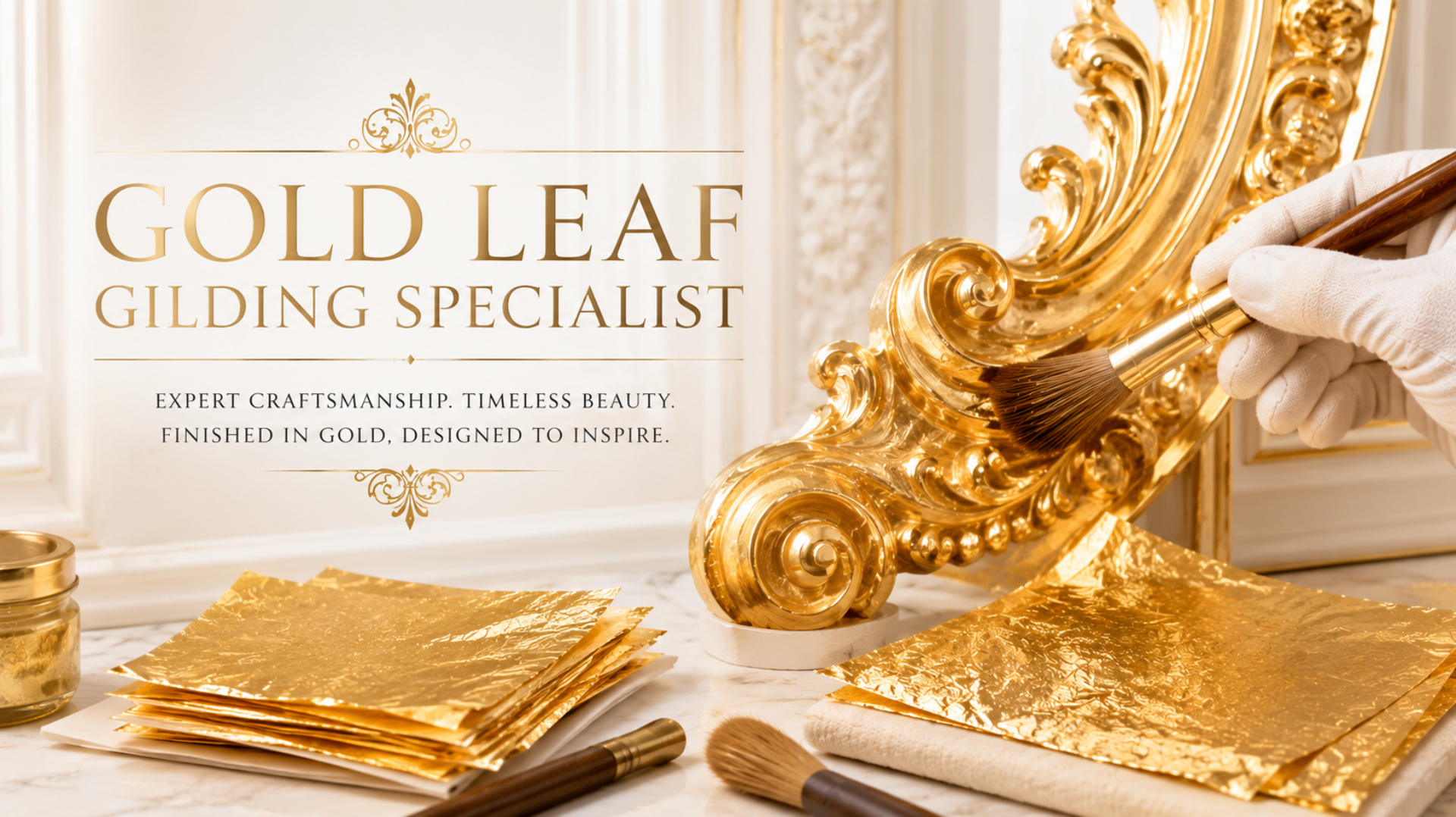
Gold Leaf Gilding North Carolina
Gilding Specialists provides professional gold leaf gilding services throughout North Carolina, helping homeowners, businesses, designers, churches, historic properties and restoration projects create beautiful decorative finishes with genuine gold leaf.
Gold leaf gilding is a traditional decorative technique that has been used for centuries to enhance architectural details, furniture, artwork, frames, decorative objects and important interiors. When carefully applied by an experienced specialist, gold leaf can produce a refined finish with exceptional depth, warmth and visual character.
Gilding Specialists works with clients across North Carolina who require new gold leaf finishes, restoration of existing gilding, decorative gilding and specialist restoration work. Each project can be approached according to the age, material, condition and intended appearance of the item or surface.
Professional Gold Leaf Gilding in North Carolina
Gold leaf gilding requires considerably more than simply applying sheets of gold to a surface. The preparation underneath the gold, the choice of gilding method and the application technique all influence the final result.
Gilding Specialists can assist with projects involving architectural details, decorative features, furniture, frames, sculptures, ornamental objects and other surfaces where a high-quality gold finish is required.
Depending on the project, gilding may involve traditional water gilding, oil gilding or other specialist techniques selected according to the substrate and desired finish.
The objective is to create a finish that looks appropriate for the setting while providing the level of detail and craftsmanship expected from specialist decorative restoration.
What Is Gold Leaf Gilding?
Gold leaf gilding is the process of applying extremely thin sheets of gold to a prepared surface. Genuine gold leaf is exceptionally delicate, meaning that the underlying surface must be carefully prepared before the gold can be applied.
Traditional gilding may involve several stages, including cleaning and preparation, application of a suitable ground, smoothing and preparation of the surface, application of the gold leaf and subsequent finishing.
The precise process depends on the object or architectural feature being gilded.
Gold leaf can be used to produce a range of appearances, from highly polished decorative surfaces to softer, aged and historically appropriate finishes.
Gold Leaf Gilding for Historic Properties
North Carolina has a substantial collection of historic buildings and architectural resources. The North Carolina State Historic Preservation Office provides preservation guidance and maintains HPOWEB, which allows historic resources throughout the state to be researched.
For historic properties, gold leaf gilding should be approached with particular care.
Existing gilding may contain important evidence of the original decorative scheme. Removing, covering or replacing historic finishes without suitable assessment can affect the appearance and character of a building or object.
Gilding Specialists can work with property owners, restoration professionals, designers and other specialists where decorative gold finishes form part of a wider restoration project.
Traditional Gold Leaf Gilding
Traditional gilding methods remain important where authenticity and craftsmanship are priorities.
Water gilding is commonly associated with highly refined decorative work and can produce a smooth, luminous surface capable of being polished to a high sheen.
Oil gilding uses an oil-based adhesive system and can be suitable for a variety of decorative and architectural applications. It can also be used where the characteristics of the surface or the requirements of the project make an oil-based approach appropriate.
The correct technique depends on the material, location, exposure, desired appearance and intended lifespan of the finish.
Gold Leaf Restoration
Existing gilded surfaces can deteriorate for many reasons, including age, handling, moisture, abrasion, inappropriate cleaning and previous restoration work.
Gold leaf restoration can involve careful cleaning, consolidation, localised repairs, replacement of missing areas and sympathetic finishing.
The objective is not always to make an older gilded surface appear completely new. In many restoration projects, retaining appropriate evidence of age can be an important part of the overall appearance.
A specialist assessment can help determine whether a surface requires complete regilding, localised repair or conservation-led treatment.
Architectural Gold Leaf Gilding
Gold leaf can provide an impressive finish for architectural details and decorative features.
Potential applications include:
- Decorative mouldings
- Ornamental plasterwork
- Ceiling features
- Cornices
- Columns
- Capitals
- Decorative panels
- Fireplaces
- Furniture
- Doors
- Frames
- Sculptural details
- Decorative metalwork
- Interior architectural features
- Commercial interiors
- Religious buildings
- Historic interiors
Gold leaf can be used selectively to highlight individual details or across larger decorative schemes.
Gold Gilding for Furniture and Decorative Objects
Furniture and decorative objects can benefit from carefully executed gold leaf work.
Gilded mirrors, picture frames, furniture details, sculptures and ornamental pieces can develop worn or damaged areas over time. Professional restoration can help improve their appearance while retaining important decorative characteristics.
The appropriate preparation and gilding method will depend on the material and construction of the object.
Gold Leaf for Churches and Religious Buildings
Churches and other religious buildings often contain decorative features where gilding plays an important visual role.
Gold leaf may be found on architectural ornamentation, frames, sculptures, decorative lettering and other elements.
Restoration of these features requires attention to detail because the gilding often forms part of a larger historic decorative scheme.
Gilding Specialists can provide specialist guidance for projects involving the restoration, repair or creation of decorative gold finishes.
Gold Leaf Gilding for Commercial Interiors
Gold leaf can also be incorporated into contemporary commercial interiors.
Restaurants, hotels, boutiques, private clubs, offices and luxury residential developments may use gilded details to introduce a distinctive decorative feature.
Modern gilding does not necessarily have to imitate an antique appearance. Gold leaf can be incorporated into contemporary designs while maintaining the craftsmanship associated with traditional gilding.
Genuine Gold Leaf and Decorative Finishes
The appearance of a gilded surface depends on several factors, including the type of gold leaf, preparation, application technique and final treatment.
Different gold alloys and grades can create subtly different colours and visual effects.
Gold leaf may be selected according to the desired appearance of the project, with yellow gold, white gold and other specialist options available for appropriate applications.
For restoration work, matching an existing finish can be more important than simply selecting the brightest gold available.
Gold Leaf Gilding for Interior Designers and Restoration Professionals
Gilding Specialists can work alongside interior designers, architects, decorators, furniture restorers and restoration contractors.
Working from an established decorative scheme can help ensure that gilded details complement surrounding materials and finishes.
For restoration projects, coordination with other trades may also be necessary where plasterwork, woodwork, masonry, decorative painting or architectural conservation is involved.
Why Choose Gilding Specialists?
Gilding requires patience, precision and an understanding of how different materials respond to preparation and application.
Gilding Specialists approaches each project individually rather than treating every surface in the same way.
The process can include:
- Assessment of the existing surface
- Identification of the underlying material
- Preparation and cleaning
- Selection of an appropriate gilding method
- Careful application of gold leaf
- Finishing and detailing
- Restoration of damaged areas where appropriate
- Attention to the surrounding decorative scheme
This approach is particularly important when working with valuable, historic or highly detailed pieces.
Gold Leaf Gilding Across North Carolina
Gilding Specialists serves clients throughout North Carolina, from major metropolitan areas to smaller communities and historic towns.
North Carolina contains a wide range of architectural environments, from historic coastal properties to traditional homes, urban commercial buildings and mountain properties. This variety means that gilding projects can involve very different materials, styles and conservation requirements.
Gilding Specialists can discuss the requirements of individual projects and determine an appropriate approach based on the surface, location and desired result.
Cities and Municipalities Served in North Carolina
For local search coverage, Gilding Specialists can serve clients throughout North Carolina, including the following incorporated cities and municipalities commonly searched as cities:
Albemarle, Archdale, Asheboro, Asheville, Belmont, Bessemer City, Boiling Spring Lakes, Brevard, Burlington, Charlotte, Cherryville, Claremont, Clinton, Concord, Conover, Creedmoor, Dunn, Durham, Eden, Elizabeth City, Fayetteville, Gastonia, Goldsboro, Graham, Greensboro, Greenville, Havelock, Henderson, Hendersonville, Hickory, High Point, Jacksonville, Kannapolis, Kings Mountain, Kinston, Laurinburg, Lenoir, Lexington, Lincolnton, Lumberton, Mebane, Monroe, Morganton, Mount Airy, Mount Holly, Mount Olive, New Bern, Newton, Oxford, Raleigh, Reidsville, Roanoke Rapids, Rockingham, Rocky Mount, Roxboro, Salisbury, Sanford, Shelby, Statesville, Thomasville, Trinity, Washington, Whiteville, Wilmington, Wilson and Winston-Salem.
North Carolina’s municipal structure is unusual because the terms city, town and village do not create separate legal classes of municipality. The current Census Bureau incorporated-place data therefore includes municipalities with all three designations.
Gilding Specialists can therefore work with clients across the wider network of North Carolina communities, including towns and villages surrounding the larger cities.
Gold Leaf Gilding in Charlotte
Charlotte is North Carolina’s largest city and has a diverse mixture of modern, traditional and historic properties.
Gold leaf can be used within luxury interiors, commercial spaces, decorative furniture, architectural features and restoration projects.
Gold Leaf Gilding in Raleigh
Raleigh combines contemporary development with historic architecture and established residential neighbourhoods.
Gold leaf gilding can be incorporated into restoration projects, private residences, commercial interiors and decorative architectural schemes throughout the Raleigh area.
Gold Leaf Gilding in Asheville
Asheville is particularly well known for historic architecture, distinctive interiors and decorative arts.
Gilded architectural details can form an important part of period restoration and high-end interior projects, making specialist gilding appropriate for a variety of applications.
Gold Leaf Gilding in Wilmington
Wilmington’s historic architecture provides opportunities for specialist decorative restoration, including the conservation and renewal of gilded architectural features, frames, furniture and ornamental details.
Gold Leaf Gilding in Greensboro and Winston-Salem
Gilding Specialists also works with clients in Greensboro, Winston-Salem and surrounding communities.
Projects can range from contemporary decorative work to the restoration of traditional interiors and individual gilded objects.
Gold Leaf Gilding for Historic Restoration
Gold leaf can be an important component of historic restoration.
Where an original gilded surface survives, assessment should take place before significant cleaning or alteration. Layers of previous finishes can sometimes provide useful information about the history of an object or building.
A sympathetic restoration approach can preserve existing character while addressing areas of damage or loss.
For historic properties, clients may also need to consider applicable preservation requirements and professional advice. North Carolina’s State Historic Preservation Office provides technical preservation services and information concerning historic rehabilitation.
Bespoke Gold Leaf Gilding
Every gilding project has different requirements.
A small antique frame may require an entirely different treatment from a large architectural interior. Similarly, a new decorative feature may require a different approach from the restoration of a centuries-old gilded surface.
Gilding Specialists can develop an approach around the existing material, decorative style, condition and desired finish.
Frequently Asked Questions
What is gold leaf gilding?
Gold leaf gilding is the process of applying extremely thin sheets of gold to a prepared surface. It is a traditional decorative technique used on architecture, furniture, frames, sculptures and other objects.
Is genuine gold used in gold leaf gilding?
Genuine gold leaf is available in different grades and colours. The appropriate type depends on the intended appearance, application and requirements of the project.
Can old gold leaf be restored?
Yes. Existing gilding can sometimes be cleaned, repaired or restored rather than completely replaced. The appropriate approach depends on the condition and historical importance of the surface.
Can you gild architectural features?
Gold leaf can be applied to many suitable architectural features, including decorative mouldings, ornamental details, columns, capitals, fireplaces and other prepared surfaces.
Can gold leaf be used on furniture?
Yes. Gold leaf is traditionally used on furniture, frames and decorative objects. The preparation and gilding technique depend on the material and existing finish.
What is the difference between water gilding and oil gilding?
Water gilding uses a water-based adhesive system and is associated with highly refined traditional gilding. Oil gilding uses an oil-based size and is suitable for different applications. The appropriate method depends on the surface and desired result.
Can gold leaf gilding be used in modern interiors?
Yes. Gold leaf can be incorporated into contemporary interiors as well as traditional and historic settings. It can be used to create subtle highlights or more prominent decorative features.
Can you match existing gold leaf?
Existing finishes can often be assessed to determine the most appropriate colour, sheen and gilding method. Exact matching depends on the age, condition and composition of the original finish.
Is gold leaf suitable for exterior applications?
Certain gilding techniques and gold leaf products can be used for exterior applications, but suitability depends on exposure, substrate and environmental conditions. The surface should be assessed before selecting a system.
Do you work on historic buildings?
Gilding Specialists can work on projects involving historic buildings and decorative restoration. Where appropriate, gilding work can be coordinated with other restoration professionals and preservation specialists.
How do I arrange a gold leaf gilding project in North Carolina?
The first step is to discuss the object, architectural feature or surface requiring gilding. Photographs and information about the material, dimensions, condition and location can help establish the appropriate approach.
Professional Gold Leaf Gilding in North Carolina
Gold leaf gilding combines traditional craftsmanship with detailed surface preparation and specialist application techniques. Whether the requirement is restoration of an existing gilded feature, decorative gilding for a new interior or specialist work on furniture and architectural details, choosing an experienced gilding specialist can make a significant difference to the finished result.
Gilding Specialists provides professional gold leaf gilding services for clients throughout North Carolina, working on residential, commercial, decorative and restoration projects.
From Charlotte and Raleigh to Asheville, Wilmington, Greensboro, Winston-Salem and communities throughout the state, Gilding Specialists can assist with bespoke gold leaf gilding and restoration requirements.